
Play Dice Now!
Home → Auto Cashout
Dice Auto Cashout
Auto cashout in Dice
The auto cashout feature in Spribe's Dice operates by closing a bet automatically at a chosen multiplier, removing reaction time from the outcome. This automation does not change the built-in house edge of 3.00%, ensuring the theoretical return remains fixed at 97.00% regardless of player speed. Players can set this threshold anywhere between 1.1x and 970x to align with their risk appetite.
Dice round parameters
| Max multiplier | x970 |
| RTP | 97.00% |
| Bet range | $0.10 - $100 |
Spribe’s implementation allows for precise control over exit points, contrasting with games like Aviator which offer a max win of x1,000,000 but require manual intervention. While Chicken Road provides a potential payout of x3,608,855, its mechanics differ significantly from Dice's instant single-round prediction model. The Dice engine processes these automatic closures instantly without live cash-out phases during a round.
This functionality ensures consistent execution of betting strategies without emotional interference or latency issues. A user setting a target at 2.0x guarantees that winnings are secured if the roll exceeds the threshold defined by that multiplier. The system calculates the payout based on the predefined slider position before the server seed determines the result.
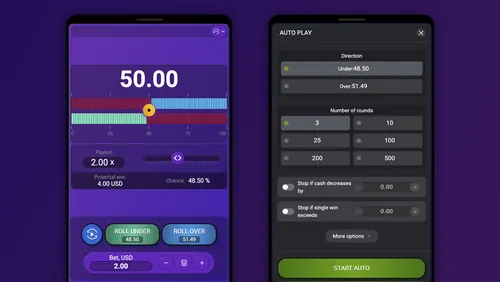
Setting a target multiplier
Players configure the target multiplier using an adjustable win-chance slider within the 0.00-99.99 range offered by Spribe. Adjusting this slider directly sets the payout multiplier, ranging from 1.1x up to 970x, inversely correlating with the probability of winning. This mechanism defines the volatility dynamically, allowing users to select their desired risk level for each individual round.
The maximum possible win cap is x970, which stands in stark contrast to Tower Rush by Galaxsys that caps at 100x. Conversely, Fish Road by InOut Games offers a significantly higher max win of x2,542,251.93, reflecting its different volatility structure. Dice maintains a balanced approach with its RTP of 97.00%, providing a middle ground between low-risk steady gains and high-variance jackpots.
Selecting a lower target increases the hit frequency while reducing the payout per successful round, optimizing bankroll longevity. For instance, aiming for 1.1x yields frequent small wins, whereas targeting 970x requires enduring long losing streaks. The provably fair algorithm verifies each outcome via server/client seed and nonce, ensuring transparency in how the multiplier was determined.
Why automation removes hesitation
Automation eliminates the psychological delay between seeing a result and acting upon it, which is critical in instant resolution games. Unlike Plane Game by Spribe where high volatility demands quick decisions, Dice relies on pre-set parameters to execute trades. This removal of hesitation prevents players from chasing losses or deviating from their initial strategic plan mid-session.
Spribe designed Dice as a single-round prediction game rather than a climbing-multiplier crash, reducing the pressure for split-second reactions. The game releases no reels or paylines, focusing solely on whether the roll lands higher or lower than the target number. This simplicity allows auto-bet options to function reliably without complex state management during the brief duration of a round.
By pre-defining exit points, players avoid the common pitfall of greed that often erodes profits in high-speed environments. The house edge of 3.00% remains constant regardless of whether the decision is made manually or by script. This consistency ensures that long-term performance aligns with the theoretical RTP of 97.00% over hundreds of thousands of rounds.
Low targets versus high targets
Low targets such as 1.1x provide high win probability but minimal returns, suitable for grinding out wagering requirements efficiently. High targets approaching 970x offer substantial payouts but occur infrequently, requiring significant bankroll reserves to survive variance. This dichotomy allows players to tailor their session goals, whether seeking stability or occasional large wins.
Comparing Dice to other titles reveals distinct risk profiles; Chicken Road boasts a max win of x3,608,855 with an RTP of 98.00%. In contrast, Dice limits its top prize to x970 while maintaining a competitive 97.00% RTP and adjustable volatility. Players must choose between the rare jackpots of InOut Games' offerings or the controlled variance of Spribe's Dice.
Adjusting the slider changes the mathematical expectation for each bet, impacting the required bet size relative to the bankroll. A strategy focusing on low multipliers may generate many small wins, masking the cumulative effect of the 3.00% house edge. Conversely, high-target strategies rely on statistical outliers to offset the high probability of loss in any given round.
Auto bet alongside auto cashout
Auto-bet options enable continuous play by automatically placing wagers after each settlement, integrating seamlessly with auto cashout triggers. This combination allows for unattended operation within the $0.10 to $100 betting range supported by Spribe. Users can define stop-loss limits or win goals to manage exposure during extended automated sessions.
While Dice focuses on single-round predictions, competitors like Aviator also support auto features but operate on different mechanics with a max win of x1,000,000. The structural difference means Dice's automation handles discrete events rather than tracking a rising curve until collapse. This distinction simplifies the logic required for reliable auto-betting scripts and reduces computational overhead.
The integration of these tools supports disciplined banking by enforcing predetermined rules without human intervention. With a theoretical return of 97.00%, consistent application of auto-strategies helps mitigate emotional decision-making errors. Players utilizing both features should monitor their balance closely, as rapid succession of rounds accelerates the impact of the house edge.
Dice: key facts
| Parameter | Value |
|---|---|
| Game | Dice |
| Studio | Spribe |
| Released | 2021 |
| RTP | 97.00% |
| House edge | 3.00% |
| Volatility | adjustable |
| Max win | x970 |
| Bet range | $0.10 – $100 |
Choosing a cashout target
Spribe defines the Dice game with a theoretical return to player of 97.00 percent, establishing a house edge of exactly three percent for all wagers placed on the platform. This mathematical baseline remains constant regardless of the specific risk slider position selected by the user during the betting phase. Consequently, the long-term financial expectation is fixed at this percentage rather than fluctuating based on short-term session outcomes or individual bet sizes.
The maximum possible win cap is set at x970, which serves as the absolute upper limit for any single successful prediction round within the game. Players aiming for this highest multiplier must select a very low probability target, thereby accepting a significantly reduced chance of winning each individual round. This trade-off between frequency and magnitude requires careful consideration before placing any real money bet on the digital interface.
A standard betting range spans from $0.10 up to $100, allowing players to adjust their stake size according to their total bankroll management strategy. Selecting a target number between 0.00 and 99.99 directly influences the payout multiplier, creating a customizable risk profile for every single round played. Understanding this relationship helps users align their betting behavior with their desired volatility level and potential reward expectations.
Frequency against payout size
InOut Games releases Rabbit Road with an RTP of 95.50 percent and a massive max win of x3,608,855, contrasting sharply with Dice's lower ceiling. While Dice offers a higher RTP of 97.00 percent, its maximum win is restricted to x970, limiting the potential for extreme jackpot scenarios in comparison. This structural difference means that high-frequency small wins are more likely in Dice, whereas Rabbit Road favors rare but substantial payouts over time.
Chicken Road 2, also from InOut Games, shares the same 95.50 percent RTP and identical x3,608,855 max win potential as its sibling title. The volatility remains medium, suggesting a balanced distribution of wins that differs from the adjustable risk slider found in Spribe's Dice product. Users comparing these titles should note that Dice allows manual adjustment of win-chance, providing direct control over the frequency versus payout ratio.
TaDa Gaming's Chicken Dash features a high volatility setting with a 96.85 percent RTP and a max win of 20,659x, sitting between the other options. Unlike Dice, which caps wins at x970, Chicken Dash offers significantly higher upside potential despite having a slightly lower theoretical return percentage. This comparison highlights how different studios prioritize either consistent returns or occasional large payouts within their instant game portfolios.
Testing targets in demo
The provably fair mechanism in Dice relies on server and client seeds combined with a nonce to verify every single round outcome independently. This transparency allows players to audit results without relying on trust alone, ensuring that the random number generation process remains unbiased and secure throughout gameplay. Such verification methods are standard for modern crash games but provide an additional layer of confidence for users testing strategies in demo mode.
Auto-bet options enable players to automate sequences of bets, which can be useful for testing different target numbers without manual intervention during each round. This feature removes reaction time from the outcome but does not alter the built-in house edge of three percent established by the 97.00 percent RTP. Using automation in demo mode helps users understand how quickly balances can deplete when targeting high multipliers like x970 repeatedly.
Adjusting the win-chance slider changes the payout multiplier dynamically, ranging from 1.1x up to the maximum of 970x depending on the chosen probability. Setting a target near 50 percent yields low multipliers close to 1.1x, while aiming for extremes approaches the x970 cap with minimal success rates. Observing these shifts in demo mode clarifies the mathematical relationship between risk selection and expected return per wager placed.
Adjusting after a losing streak
The minimum bet of $0.10 provides a floor for recovery attempts, allowing players to reduce stake sizes significantly after experiencing consecutive losses on high-target bets. Lowering the wager helps preserve the remaining bankroll while still participating in rounds that offer the same 97.00 percent theoretical return structure. This conservative approach mitigates rapid depletion compared to maintaining larger stakes during volatile downward trends in session performance.
Conversely, increasing the bet to the $100 maximum after losses often leads to faster ruin unless the player hits the x970 max win cap immediately. Chasing losses with high stakes ignores the independent nature of each roll, where previous outcomes do not influence future probabilities in this provably fair system. Maintaining discipline around the fixed three percent house edge prevents emotional decisions that typically accelerate balance exhaustion during negative variance periods.
Comparing this to Mines, which also boasts a 97.00 percent RTP but lacks a published studio name, reveals similar mathematical foundations across instant games. However, Dice's adjustable volatility slider offers more granular control over risk exposure than static games like Plinko, which share the same RTP but fixed mechanics. Users adjusting strategies should recognize that no betting system alters the underlying house edge, making bankroll management crucial for longevity.
When to turn automation off
The welcome bonus of 300 percent up to €2,000 plus 100 free spins introduces external conditions that may restrict automated play patterns or specific game contributions. Automated bets might not count fully toward wagering requirements depending on the casino's terms, so turning off automation ensures manual oversight of eligible activity. Verifying these rules prevents accidental violation of bonus conditions that could result in forfeiture of winnings derived from automated sequences.
Auto cashout closes a bet automatically at a chosen multiplier, removing human reaction time but not changing the inherent three percent house edge of the game. While convenient for maintaining consistent targets, it fails to adapt to real-time bankroll fluctuations or unexpected variance spikes during extended sessions. Disabling automation allows for reactive adjustments based on current balance status, ensuring that stake sizes remain aligned with sustainable gambling practices.
Rabbit Road's x3,608,855 max win potential suggests that high-variance games may require more active monitoring than Dice's capped x970 environment. Since Dice's maximum payout is relatively modest, automation risks draining funds faster if the algorithm persists through long losing streaks without manual intervention. Turning off auto-bet functions enables players to pause and reassess whether continuing with the same target probability remains mathematically justified given recent outcomes.
Double bet setups
The Dice game by Spribe allows a player to place two simultaneous bets within a single round, utilizing the adjustable volatility slider for each stake independently. This mechanic enables the allocation of capital across different risk profiles, ensuring that one loss does not necessarily wipe out the entire bankroll during a session. The maximum win cap of x970 applies to each individual bet, providing substantial upside potential even when stakes are split between two distinct outcomes.
Spribe designed this instant-result game to support concurrent wagers, where each bet operates on its own target number range from 0.00 to 99.99. Players can set auto-bet options for both lines, automating the process without manual intervention for every single round or outcome generation event. This setup requires careful monitoring of the server seed and client seed to verify the provably fair nature of each independent result as it occurs.
The minimum bet of $0.10 per line means a double setup starts at a total stake of $0.20, fitting within the $100 maximum limit per round. This structure allows for fine-tuned risk management, as the house edge remains fixed at 3.00% regardless of how many active bets are placed simultaneously. Such configuration is particularly useful for players seeking to hedge against the inherent variance of crash-style mechanics while maintaining consistent exposure to the game loop.
Splitting stakes across two bets
Dividing the wagering budget across two separate targets in Spribe's Dice offers a strategic approach to managing the theoretical return rate of 97.00% over time. By assigning different multipliers to each stake, players can balance high-risk attempts against safer, lower-multiplier outcomes to smooth out the volatility inherent in the game design. This method ensures that losses on one line might be offset by smaller wins on the other, preserving capital during extended playing sessions.
The adjustable win-chance slider dictates the payout multiplier for each bet, ranging from 1.1x up to 970x depending on the chosen probability threshold. When splitting stakes, a player might select a low-target bet for frequent small returns and a high-target bet for occasional large payouts, optimizing the expected value. The instant result feature guarantees that both outcomes are determined immediately, allowing for rapid reassessment of the betting strategy based on real-time performance metrics.
A typical split might involve allocating $50 to a safe bet with a 48% chance of winning and $50 to a risky bet with a 2% chance. This distribution utilizes the full $100 maximum bet limit per round, testing the limits of the bankroll while exploring the upper bounds of the x970 max win potential. Such precision in stake division highlights the flexibility of the platform compared to traditional slot games that lack such granular control over individual wager parameters.
Combining a safe and a risky target
Merging a conservative target with an aggressive one in Spribe's Dice creates a hybrid strategy that balances the 3.00% house edge against the desire for larger gains. The safe bet, often targeting a multiplier near 1.1x, provides steady returns that help cover operational costs, while the risky bet aims for the x970 maximum win cap. This combination leverages the adjustable volatility feature to tailor the risk profile to the player's current financial situation and tolerance for variance in the short term.
The provably fair algorithm ensures that the outcome of the safe bet and the risky bet are independent events, governed by the server seed and nonce combination. Players must understand that the 97.00% RTP is a long-term average, meaning short-term results will fluctuate significantly around this mean despite the balanced approach. Monitoring the auto-cashout settings for both targets is crucial, as manual intervention may lead to suboptimal decisions during fast-paced rounds of the instant game.
Using the minimum bet of $0.10 for the safe line and a higher stake for the risky line allows for asymmetric risk exposure within the same round. This tactic exploits the non-linear relationship between win probability and payout multiplier, aiming to generate net positive results over hundreds of rounds. The instant resolution of each bet means that the player receives immediate feedback, enabling quick adjustments to the target numbers based on the previous round's outcome and current bankroll status.
Limits of any automated plan
Automated betting plans in Spribe's Dice rely on predefined rules to execute bets, but they cannot overcome the fundamental mathematical advantage held by the casino's 3.00% house edge. Even with sophisticated algorithms adjusting stakes based on previous outcomes, the theoretical return of 97.00% ensures that long-term profitability is statistically impossible without external factors. The auto-bet feature streamlines the process but does not alter the underlying probabilities or the random nature of the server-generated seeds used for each round.
The maximum win cap of x970 imposes a hard limit on the potential payout for any single bet, regardless of how favorable the target selection appears to the automation script. Automated systems often fail to account for the diminishing returns associated with chasing high multipliers, leading to rapid depletion of funds during losing streaks. This constraint highlights the importance of understanding that no betting system can guarantee success in a game governed by pure chance and fixed odds.
Players utilizing auto-bet options must remain vigilant about the total amount wagered, as the speed of the instant results can lead to unintended accumulation of losses. The $100 maximum bet limit per round restricts the ability to recover losses through aggressive staking strategies like Martingale, which require exponential increases in wager size. Consequently, automated plans are best suited for entertainment purposes rather than profit generation, given the immutable nature of the game's built-in edge and structural limits.
What automation cannot fix
No automated strategy can eliminate the 3.00% house edge embedded in Spribe's Dice, as the game's mathematics ensure a negative expected value for the player over time. While auto-bet features allow for precise control over stake sizes and target numbers, they do not influence the randomness of the provably fair algorithm governing each round. Players relying solely on automation may overlook the critical need for responsible bankroll management, assuming that systematic play guarantees consistent returns despite the inherent variance.
The adjustable volatility slider and the wide range of multipliers from 1.1x to 970x offer flexibility, but they cannot be manipulated by software to shift the odds in the player's favor. Automation tools execute trades based on historical data, yet each roll in Dice is an independent event unaffected by previous outcomes due to the use of unique server and client seeds. This independence means that patterns perceived by automated systems are illusory, and past performance provides no reliable indication of future results in this instant-game format.
Even with a maximum win potential of x970, automated plans often struggle to capture these rare events due to strict stop-loss limits or insufficient capital reserves. The requirement for a minimum bet of $0.10 and a maximum of $100 per round further constrains the effectiveness of progression-based systems that rely on infinite resources. Ultimately, the limitations of automation underscore the reality that Dice remains a game of chance, where luck plays a more significant role than any pre-programmed strategy could ever hope to override.
DemoRTP & VolatilityHow to PlayAuto CashoutStrategyBonusesMobileDownload & AppMax WinSimilar GamesReviewFAQSitemap
Dice 2026