
Play Dice Now!
Home → Similar Games
Games Similar to Dice
Games close to Dice
Spribe released Dice in 2021 as a distinct crash title featuring an adjustable volatility slider that ranges from conservative to aggressive risk levels, allowing players to tailor their exposure before each round begins. This mechanic differs fundamentally from traditional slot machines, which rely on spinning reels and fixed paylines to determine outcomes based on symbol combinations rather than mathematical probability sliders.
The maximum win cap for this specific Spribe product stands at x970, establishing a clear upper limit on potential payouts compared to other instant games in the market. Players can wager amounts between $0.10 and $100 per round, providing flexible bankroll management options while engaging with the provably fair algorithm that generates results using server and client seeds.
Aviator, another popular title by Spribe, offers a significantly higher maximum win of x1,000,000, contrasting sharply with the more modest x970 ceiling found in Dice. While both games share the same developer and instant-result format, the payout structures differ substantially, requiring players to adjust their betting strategies accordingly when switching between these high-variance environments.
Titles with similar maths
Chicken Road by InOut Games presents a theoretical return to player rate of 98.00%, which exceeds the 97.00% RTP offered by Dice, making it mathematically favorable over long-term play sessions. The maximum win potential reaches an astonishing x3,608,855, vastly outstripping the x970 limit inherent to the Dice game mechanics and altering the risk-reward profile for participants seeking larger jackpots.
Fish Road, also developed by InOut Games, maintains a lower RTP of 96.00% compared to Dice's 97.00%, resulting in a higher house edge for players engaging with this particular title. Its maximum win capability is recorded at x2,542,251.93, demonstrating how different mathematical models within the same genre can produce varied volatility patterns and payout distributions across multiple rounds.
Tower Rush from Galaxsys matches the 97.00% RTP figure seen in Dice but caps its maximum win at only 100x, creating a low-volatility experience that contrasts with the high-risk adjustable settings available in Dice. This structural difference means players face smaller but more frequent payouts, diverging from the binary outcome nature of prediction-based crash games where timing determines success or failure entirely.
Same studio alternatives
Spribe developed Plane Game, which shares the identical 97.00% RTP percentage found in Dice while introducing a high volatility setting that impacts win frequency and payout size distribution. This title operates within the same instant-game category, utilizing comparable provably fair algorithms to generate transparent results without relying on traditional reel mechanisms or payline structures common in slots.
Both Aviator and Plane Game originate from Spribe, maintaining consistent quality standards through their shared 97.00% theoretical return metrics despite differences in visual themes and gameplay animations. Aviator allows for massive wins up to x1,000,000, whereas Plane Game emphasizes high volatility characteristics that appeal to players preferring erratic payout patterns over steady returns during extended gaming sessions.
Dice itself features an adjustable volatility parameter, offering players direct control over their risk exposure unlike fixed-volatility titles such as Plane Game. This unique feature allows users to modify their win-chance slider dynamically, influencing the multiplier range from 1.1x up to 970x, thereby personalizing the mathematical expectations associated with each individual round played.
Comparable volatility
Dice allows players to adjust volatility manually via a win-chance slider, enabling customization of risk levels that directly influence the payout multiplier ranging from 1.1x to 970x. This adjustable mechanism provides greater control over expected variance compared to fixed-volatility games like Tower Rush, which maintains a constant low-risk profile throughout every session regardless of player preference.
Plane Game by Spribe utilizes a high volatility setting that remains static, meaning players cannot alter the risk parameters mid-session as they can with Dice. This fixed approach creates a different pacing structure where outcomes are determined solely by chance within predefined boundaries, contrasting with Dice's interactive model where strategy plays a significant role in managing bankroll effectively.
Chicken Road exhibits extreme volatility due to its massive x3,608,855 maximum win potential, requiring substantial patience and tolerance for dry spells between large payouts. In contrast, Dice limits its highest possible win to x970, offering a more balanced risk-reward dynamic that appeals to players seeking manageable volatility levels without sacrificing the thrill of high-multiplier opportunities.
How these titles differ
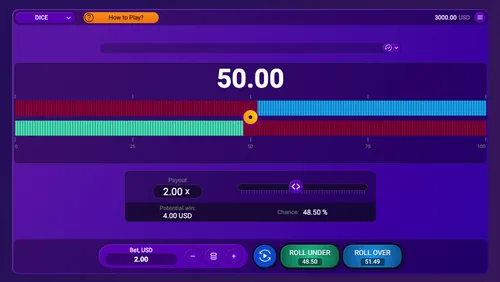
Dice from Spribe operates as a single-round prediction game where players select a target number on a 0.00-99.99 range and bet whether the roll lands higher or lower, yielding an instant result without any climbing multiplier phase or live cash-out window during the round. This structure contrasts sharply with Rabbit Road by InOut Games, which features a maximum win of x3,608,855 and relies on a different risk progression model that allows for significantly larger potential payouts compared to Dice's fixed ceiling. The core mechanic in Dice remains purely based on probability thresholds set by the player rather than navigating a path of increasing multipliers found in other crash-style titles.
The volatility in Dice is fully adjustable by the user through a win-chance slider that directly sets the payout multiplier ranging from 1.1x up to 970x, giving immediate control over risk exposure before each roll occurs. This stands in contrast to Chicken Road 2 by InOut Games, which maintains a fixed medium volatility setting alongside its massive x3,608,855 max win potential, offering a less customizable risk profile for players seeking consistent variance levels. Players choosing Dice can dynamically shift their strategy between low-risk frequent wins and high-risk rare hits within the same session, whereas games like Chicken Road require accepting a pre-defined volatility curve.
Provably fair technology ensures every outcome in Dice is verifiable via server and client seeds combined with a nonce, allowing players to independently confirm the fairness of each roll against the published algorithmic parameters. While Mines and Plinko also claim 97.00% RTP, they lack the specific adjustable risk slider mechanism that defines Dice, forcing players to accept static mathematical models rather than actively manipulating their win chance percentage. This transparency in Dice empowers users to understand exactly how their chosen probability translates into the corresponding multiplier value, creating a direct link between decision and reward that is absent in fixed-parameter alternatives.
Dice compared with similar titles
| Game | Studio | RTP | Volatility | Max win |
|---|---|---|---|---|
| Dice | Spribe | 97.00% | adjustable | x970 |
| Tower Rush | Galaxsys | 97.00% | — | 100x |
| Chicken Road | InOut Games | 98.00% | — | x3,608,855 |
| Fish Road | InOut Games | 96.00% | — | x2,542,251.93 |
| Aviator | Spribe | 97.00% | — | x1,000,000 |
| Rabbit Road | InOut Games | 95.50% | — | x3,608,855 |
| Chicken Road 2 | InOut Games | 95.50% | medium | x3,608,855 |
Feature sets side by side
Dice offers auto-bet options that allow players to automate sequences of wagers within the $0.10 to $100 limit, enabling hands-free gameplay while maintaining strict control over individual stake sizes and total loss limits per session. This automation feature differs from Chicken Dash by TaDa Gaming, which focuses on high volatility outcomes with a 20,659x max win but does not explicitly highlight automated betting tools in its standard feature description. The presence of auto-bets in Dice provides efficiency for strategic testing, though it requires careful monitoring to prevent rapid depletion of funds when targeting the maximum 970x multiplier caps.
The theoretical return to player (RTP) for Dice is set at 97.00%, representing a house edge of 3.00% over a very long run of hundreds of thousands of rolls, ensuring predictable long-term statistical behavior for the operator. This matches the 97.00% RTP found in Mines and Plinko, yet differs significantly from Chicken Dash by TaDa Gaming, which carries a lower 96.85% RTP, thereby retaining a slightly larger margin for the casino over extended play periods. Players analyzing expected value will find Dice offers one of the more favorable mathematical frameworks among instant games, provided they adhere to responsible bankroll management strategies.
Results in Dice are instant, occurring immediately after the bet is placed and the target number is confirmed, eliminating any waiting period associated with spinning reels or animating physical objects like chips falling in Plinko. This immediacy contrasts with Rabbit Road by InOut Games, which may involve traversal time toward its x3,608,855 max win potential, introducing a temporal element that Dice completely removes from its core loop. The speed of resolution in Dice allows for rapid iteration of bets, making it suitable for players who prefer quick feedback loops over prolonged engagement phases typical of other casino variants.
Payout ceilings compared
The maximum win cap for Dice is strictly limited to 970 times the original stake, capping the absolute highest possible payout regardless of how many consecutive successful predictions a player achieves during a session. This ceiling is substantially lower than Rabbit Road by InOut Games, which offers a staggering maximum win of x3,608,855, providing a life-changing jackpot potential that Dice simply cannot match due to its mathematical design constraints. Players seeking modest but consistent returns may appreciate Dice's capped structure, while those chasing massive outliers must look elsewhere for games with exponentially higher upper bounds.
Chicken Road 2 by InOut Games shares the identical maximum win potential of x3,608,855 as Rabbit Road, establishing a tier of high-reward instant games that dwarfs the 970x limit imposed on Dice by its developer Spribe. This comparison highlights a fundamental divergence in game design philosophy, where some providers prioritize accessible, frequent wins with smaller caps, while others engineer extreme variance to accommodate rare, enormous payouts. The 970x cap in Dice ensures that even the most aggressive betting strategies remain bounded, protecting both the player from catastrophic single-session losses and the platform from unlimited liability.
Chicken Dash by TaDa Gaming presents an intermediate maximum win scenario with a cap of 20,659x, bridging the gap between the conservative 970x limit of Dice and the astronomical figures seen in InOut Games titles. This middle-ground approach suggests that while Dice offers a safer, more controlled environment with its tight payout ceiling, alternative games provide varying degrees of risk-reward profiles for players willing to accept higher volatility. Understanding these distinct ceilings helps players align their expectations with the appropriate game mechanics, recognizing that Dice prioritizes predictability over explosive growth potential.
Bet ranges compared
Dice permits wagers starting from a minimum of $0.10 up to a maximum of $100 per round, accommodating both casual players testing strategies with small stakes and experienced users managing larger bankrolls within defined limits. This range is notably restricted compared to Chicken Dash by TaDa Gaming, which typically supports higher maximum bets in similar instant-game categories, allowing for greater exposure per single outcome. The $100 cap in Dice serves as a safeguard against excessive risk-taking, ensuring that no single roll can result in a disproportionate financial impact relative to the average player's budget.
The minimum bet of $0.10 in Dice allows for extensive exploration of the adjustable risk slider without significant financial commitment, enabling players to fine-tune their win-chance percentages across the full spectrum from low to high risk. In contrast, Rabbit Road by InOut Games often imposes higher minimum entry barriers for its x3,608,855 max win opportunities, requiring larger initial outlays to participate meaningfully in its high-variance ecosystem. This accessibility makes Dice particularly suitable for beginners who wish to understand the mechanics of provably fair prediction games without risking substantial sums on each individual trial.
The explicit $0.10 to $100 range in Dice provides clear boundaries for bankroll management, unlike games with undefined limits where players might encounter unexpected restrictions during peak traffic or promotional periods. Knowing the exact bounds allows for precise calculation of potential turnover rates and session durations, facilitating better planning for disciplined gaming sessions focused on longevity rather than short-term gains.
Which suits which player
Players who prefer complete control over their risk exposure will find Dice ideal due to its adjustable win-chance slider, which lets them manually set the probability of winning and view the corresponding multiplier before placing each bet. This customization appeals to strategists who enjoy optimizing their approach based on current bankroll status, contrasting with fixed-volatility games like Chicken Road 2 by InOut Games where the risk profile remains constant throughout play. The ability to shift between conservative and aggressive modes instantly empowers users to adapt to changing circumstances without leaving the game interface.
Those seeking simplicity and speed will appreciate Dice's instant resolution mechanic, where results appear immediately after the roll without complex animations or multi-stage processes that characterize games like Chicken Dash by TaDa Gaming. This straightforward nature reduces cognitive load, making it easier for newcomers to grasp the core concept of predicting numbers on a 0.00-99.99 scale without needing to learn intricate rules or side bets. The lack of spinning reels or climbing multipliers further streamlines the experience, focusing entirely on the mathematical relationship between probability and payout.
High rollers accustomed to chasing massive jackpots may find Dice's 970x maximum win limit restrictive compared to the x3,608,855 potential offered by Rabbit Road and Chicken Road 2 from InOut Games. However, the 97.00% RTP and provably fair verification system offer a robust framework for those prioritizing transparency and statistical fairness over sheer payout magnitude. Players valuing ethical gaming practices and verifiable outcomes will likely prefer Dice's transparent seed-based system over opaque algorithms used in some high-variance alternatives, ensuring trust in every transaction.
Trying alternatives in demo
Spribe released the original Dice title in 2021, establishing a baseline for instant-result prediction mechanics that modern players frequently test before risking real funds. This specific release date marks the introduction of a single-round provably-fair system where outcomes are determined by server and client seeds rather than random number generators alone. Players can adjust the win-chance slider to set their desired multiplier, which ranges from 1.1x up to a maximum potential payout of x970 per successful round.
The theoretical return to player stands at 97.00%, creating a house edge of exactly 3.00% that remains constant regardless of how aggressively the volatility settings are adjusted by the user. This fixed mathematical structure allows gamblers to calculate expected losses over long sessions with precision, as the 97.00% RTP applies strictly to very long runs of gameplay rather than short bursts. Understanding this percentage helps users manage their bankroll expectations when experimenting with different risk levels in the free play environment.
Why variety helps bankroll
Comparing Dice against Spaceman reveals significant differences in maximum win caps, as Pragmatic Play’s crash game offers a potential payout of 5000x compared to Dice’s limit of x970. This disparity means that chasing high multipliers requires a different budget allocation strategy, since the lower cap on Dice forces players to rely on frequency rather than sheer magnitude for returns. A bankroll designed for Spaceman might deplete quickly if applied directly to Dice without adjusting for the reduced top-end reward potential available in each session.
Studios worth knowing
Spribe pioneered the provably fair mechanic in crash games, allowing players to verify every outcome using server seeds, client seeds, and nonces for complete transparency in result generation. PG Soft entered the market with Fortune Rabbit, offering a distinct medium volatility experience on a non-standard 3-4-3 row grid that contrasts sharply with the linear progression of dice rolls. These two studios represent divergent design philosophies, with Spribe focusing on instant verification and PG Soft emphasizing visual complexity within a slot format.
Newer releases in the genre
Fortune Rabbit launched with an RTP of 96.75%, which is slightly lower than the 97.00% return offered by Spribe’s Dice, affecting the long-term theoretical yield for consistent players. The medium volatility setting in PG Soft’s title provides a different risk profile compared to the adjustable volatility found in Dice, where users manually control their exposure to variance. This difference in volatility management means that players switching between these titles must recalibrate their bet sizes to maintain consistent risk levels across different game mechanics.
Picking your next title
The minimum bet of $0.10 allows players to test strategies with minimal financial exposure, while the maximum stake of $100 accommodates high rollers seeking larger payouts within the x970 cap. Adjusting the target number on the 0.00-99.99 range lets users balance probability against multiplier size, creating a customizable risk environment that differs significantly from fixed payline slots. This flexibility enables precise bankroll management, as players can reduce their win chance to increase multipliers or raise probability to secure smaller, more frequent wins.
DemoRTP & VolatilityHow to PlayAuto CashoutStrategyBonusesMobileDownload & AppMax WinSimilar GamesReviewFAQSitemap
Dice 2026