
Play Dice Now!
Home → Demo
Dice Demo
What the Dice demo gives you
The theoretical return to player for Spribe's Dice stands at 97.00%, which defines the long-term payout percentage over hundreds of thousands of rounds. This metric indicates a house edge of 3.00%, meaning the casino retains three cents for every dollar wagered in the extended statistical sample. Players should understand that this figure represents an average outcome rather than a guarantee for individual gaming sessions or short-term play.
Volatility remains adjustable within the game interface, allowing users to customize risk levels before placing their wagers on each round. The maximum win cap is set at x970, limiting the highest possible payout regardless of the multiplier reached during a single betting cycle. This ceiling ensures that even high-risk strategies cannot exceed the specified reward threshold defined by the game developer's mathematical model.
Unlike traditional slots, this title features no reels, paylines, or spinning symbols, offering a distinct instant-result mechanic based on number prediction. The Provably Fair system uses server and client seeds with a nonce to verify each outcome independently after the round concludes. This transparency allows players to audit results, providing a layer of trust absent in games relying solely on random number generators.
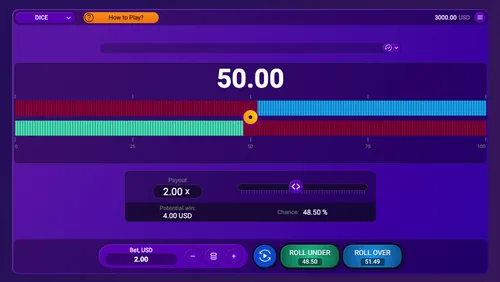
Starting the demo without registration
The demo version requires no registration or personal data submission, enabling immediate access to the Spribe game mechanics upon loading the page. Users can interact with the full feature set, including the adjustable win-chance slider and auto-bet options, without creating an account first. This frictionless entry point allows potential players to test the interface and understand the rules before committing any real funds.
Betting ranges in the demonstration mode mirror the real money limits, starting from $0.10 up to $100 per round for simulation purposes. Although the balance is virtual, the mathematical behavior of the multiplier calculation remains identical to the live version controlled by the provably fair algorithm. This consistency ensures that players experience the exact volatility and payout structures they will encounter when switching to actual currency deposits.
Comparing Dice to other titles like Aviator reveals different max win potentials, as Spribe's aircraft game offers a maximum win of x1,000,000 compared to Dice's x970. Plane Game also shares the 97.00% RTP but maintains high volatility, whereas Dice allows manual adjustment of risk parameters for each bet placed. Such comparisons help users identify which instant-game style aligns best with their preferred betting strategy and bankroll management approach.
Browser compatibility is generally broad, supporting standard web technologies required to render the instant-result prediction interface without additional software downloads. Players do not need to install mobile apps or plugins to access the core gameplay loop involving target number selection and cash-out timing. This accessibility ensures that the demo functions smoothly across various devices and operating systems commonly used by online gambling audiences.
Demo balance and bet sizes
The initial virtual balance provided in the demo mode resets automatically if the user refreshes the page or closes the browser tab entirely. This reset mechanism prevents the accumulation of permanent credits and encourages realistic testing of the $0.10 minimum bet limit against the $100 maximum cap. Players must treat each session as a fresh start to accurately assess how different bet sizes impact the longevity of their virtual funds.
Adjusting the win-chance slider directly influences the payout multiplier, ranging from 1.1x for low-probability targets up to 970x for highly specific outcomes near the edges. Setting the slider to a 50% chance yields a multiplier slightly above 2x, while narrowing the range increases the potential reward proportionally. This inverse relationship between probability and payout allows users to fine-tune their risk exposure according to their current virtual balance status.
Auto-bet options function identically in demo mode as they do in real money play, allowing for automated sequences with predefined stop-loss or win-limit conditions. These tools enable players to simulate high-frequency betting strategies without manually clicking for each of the thousands of rounds required to observe statistical trends. Utilizing these features helps users evaluate whether the 97.00% RTP holds true over large sample sizes in a controlled environment.
In comparison to Chicken Road by InOut Games, which boasts a massive max win of x3,608,855, Dice offers a more conservative top payout structure. Fish Road presents another alternative with a max win of x2,542,251.93 and a slightly lower RTP of 96.00%, contrasting with Dice's 97.00% return rate. Understanding these differences helps players manage expectations regarding potential big wins versus consistent smaller payouts in similar instant-game categories.
What carries over to real money
None of the virtual balance accumulated during the demo session transfers to the real money account, requiring a new deposit to begin playing with actual funds. The welcome bonus of 300% up to €2,000 plus 100 free spins applies only after the first qualifying deposit, separate from any demo experience. Players must treat the demo purely as an educational tool to learn mechanics rather than a method to generate transferable winnings.
Knowledge of the Provably Fair verification process carries over, as players can use the same seed and nonce logic to audit real money bets immediately after playing. Understanding how the server seed and client seed combine with the nonce ensures that users can independently verify the integrity of each outcome generated with real currency. This technical familiarity provides confidence in the fairness of the game when transitioning from simulated rounds to financial stakes.
Strategies tested using the adjustable volatility settings remain applicable, as the underlying mathematics governing the multiplier calculation do not change between demo and real modes. A strategy successful in maintaining a stable balance with a 1.1x to 2x multiplier range should theoretically perform similarly with real money under identical conditions. However, psychological factors differ significantly, so players should start with the minimum $0.10 bet to mitigate emotional decision-making risks.
Comparative analysis of other Spribe titles like Plane Game highlights that high volatility games may deplete balances faster than the adjustable risk profile of Dice. Players should consider this difference when allocating their bonus funds, opting for Dice if they prefer controlled risk over unpredictable high-variance outcomes.
Browser requirements for the demo
Modern web browsers such as Chrome, Firefox, Safari, and Edge are sufficient to run the HTML5-based interface of Spribe's Dice without additional plugins. The game relies on standard JavaScript and CSS implementations to render the sliding scale and result animations smoothly across desktop and mobile screens. Ensuring the browser is updated to the latest version prevents potential rendering issues or latency that could disrupt the instant-result gameplay experience.
Mobile devices running iOS or Android operate the demo seamlessly, adapting the layout to fit smaller screens while maintaining full functionality of the bet controls. Touch interactions replace mouse clicks for adjusting the win-chance slider and initiating auto-bet sequences, providing an equally responsive user experience on smartphones and tablets. This optimization ensures that players can switch between devices without encountering compatibility barriers or loss of feature access during their testing phase.
Internet connectivity stability affects the speed of result generation, as the provably fair calculation occurs on the server side before returning the verified outcome to the client. A slow connection may introduce slight delays in displaying the final multiplier, though it does not alter the mathematical probability or the 97.00% RTP structure. Players with unreliable connections might find it harder to track rapid rounds, making the demo useful for identifying optimal network conditions before real money play.
System resources such as RAM and CPU usage remain minimal, allowing the game to run efficiently alongside other browser tabs or background applications. Unlike graphics-intensive slot games with complex animations, Dice focuses on simple numerical displays, reducing the load on older hardware or limited-bandwidth connections. This lightweight design ensures broad accessibility, enabling users with various device capabilities to participate in the demo without performance degradation or excessive battery drain.
Dice: key facts
| Parameter | Value |
|---|---|
| Game | Dice |
| Studio | Spribe |
| Released | 2021 |
| RTP | 97.00% |
| House edge | 3.00% |
| Volatility | adjustable |
| Max win | x970 |
| Bet range | $0.10 – $100 |
Reading the paytable in demo mode
The theoretical return to player for Dice stands at 97.00 percent, which establishes a house edge of 3.00 percent over extended play sessions by Spribe. This specific percentage indicates that for every hundred units wagered, ninety-seven units are mathematically projected to be returned to players as winnings across millions of rounds. Players relying on short-term demo sessions should note that actual results will deviate significantly from this long-run average due to inherent statistical variance.
The maximum possible win cap is set at x970 times the initial stake, representing the highest payout achievable within a single betting round. This ceiling contrasts sharply with titles like Rabbit Road, which offers a substantially larger potential multiplier of x3,608,855 for high-risk strategies. Consequently, Dice prioritizes consistency and lower volatility over the chance of hitting life-changing jackpots found in other crash or instant games available online.
Players can adjust their risk profile using an adjustable slider that modifies both the win-chance probability and the corresponding payout multiplier. This mechanic allows users to select targets between 1.1x and 970x, directly influencing how frequently they expect to see winning outcomes during their session. The ability to customize these parameters ensures that the game accommodates various bankroll management styles without altering the underlying mathematical edge held by the operator.
Testing bet levels safely
The minimum allowed wager for a single round in Dice is $0.10, providing a low barrier to entry for cautious testers exploring the mechanics. This starting point enables players to verify the provably fair algorithm and understand the instant result generation without committing significant capital to each trial spin. Such minimal stakes are ideal for beginners who wish to learn the interface before increasing their exposure to market fluctuations.
Conversely, the maximum permissible bet limit reaches $100 per round, catering to high rollers seeking substantial payouts within the defined x970 win cap. This upper boundary restricts the absolute maximum loss per attempt to one hundred dollars, thereby capping the financial impact of consecutive losing streaks during testing phases. Operators enforce this limit to maintain responsible gaming standards while still offering competitive betting ranges compared to other instant games in the market.
The auto-bet feature permits automated execution of multiple rounds, allowing testers to observe system behavior under continuous play conditions without manual intervention. This tool proves essential for evaluating how quickly the balance depletes when targeting specific multipliers repeatedly over a sustained period. By utilizing automation, analysts can gather more data points regarding hit frequency and payout distribution within a condensed timeframe than manual play would allow.
How many rounds make a fair test
A single round in Dice concludes instantly once the random number generator determines whether the roll lands above or below the chosen target threshold. This immediacy means that testing the game's responsiveness and fairness requires only one interaction per outcome verification, unlike slots that demand numerous spins to assess volatility. Players can thus evaluate the core mechanics efficiently without enduring prolonged waiting periods associated with traditional reel-based casino games.
To achieve statistical significance when analyzing the 97.00 percent RTP, testers must complete hundreds of thousands of rounds, as short-term results fluctuate wildly around the mean. For practical demo purposes, completing at least five hundred rounds provides a reasonable approximation of how the adjustable win-chance slider affects overall bankroll stability. This volume allows observers to confirm that the provably fair mechanism operates correctly without needing to wait for the theoretical long-run average to materialize fully.
The nonce sequence used in the provably fair system ensures that each new round generates a unique cryptographic hash independent of previous outcomes. This technical detail guarantees that no pattern can be exploited, making every round statistically identical regardless of the total number of attempts made during a session. Understanding this independence helps testers avoid the gambler's fallacy, recognizing that past failures do not influence the probability of future successes in this instant game format.
Session length and pacing
Pacing in Dice is determined entirely by the player's choice of target multiplier, with higher targets naturally resulting in fewer but larger wins over time. A conservative approach targeting multipliers near 1.1x yields frequent small payouts, extending the duration of a session funded by a modest bankroll. In contrast, chasing the maximum x970 payout drastically reduces session longevity due to the extremely low probability of such events occurring randomly.
The release year of 2021 marks the introduction of this specific title by Spribe, establishing it as a modern alternative to older crash games with slower interfaces. Its streamlined design facilitates rapid round completion, allowing dedicated players to execute dozens of bets per minute if desired. This speed enhances engagement but also accelerates bankroll depletion, requiring disciplined stop-loss limits to prevent excessive losses during extended play periods.
Comparing Dice to Chicken Dash reveals distinct differences in volatility profiles, with the latter featuring high volatility and a max win of 20,659x versus Dice's fixed x970 cap. These structural variations dictate how long a player might remain active before exhausting their funds or achieving a significant return. Analysts recommend adjusting session length expectations based on whether the goal is consistent entertainment through frequent small wins or rare large payouts.
Common mistakes in free play
A frequent error involves misunderstanding the relationship between the adjustable win-chance slider and the resulting payout multiplier, leading to unrealistic expectations about profitability. Players often assume that setting a high win probability guarantees profit, ignoring the fact that the house edge of 3.00 percent remains constant regardless of strategy. Recognizing this mathematical reality prevents frustration when seemingly safe bets fail to cover accumulated losses over time.
Another common mistake is neglecting the difference between the theoretical RTP of 97.00 percent and actual short-term performance during demo mode testing. Users may conclude the game is rigged after experiencing a losing streak, failing to realize that variance causes temporary deviations from the long-term average. Educating oneself on statistical variance helps maintain objectivity and encourages longer observation periods to accurately assess the game's true mechanics and fairness.
Ignoring the distinction between Dice and other instant games like Mines or Plinko, which share similar RTPs but differ in gameplay structure, leads to flawed comparisons. While all three offer 97.00 percent returns, Dice relies on a binary prediction model rather than grid-based or physics-driven mechanics found in its peers. Confusing these systems results in incorrect assumptions about risk management and optimal betting strategies tailored specifically to the unique rules of this Spribe title.
Demo versus real money differences
The theoretical return of Dice stands at 97.00%, which represents the house edge of 3.00% over a very long run. This percentage defines the statistical expectation for players using real currency, whereas demo modes utilize virtual credits that carry no monetary value or withdrawal potential. Consequently, the mathematical advantage remains identical in both environments, but only real-money play involves actual financial risk and reward.
Players can adjust the volatility setting to change their win-chance slider, directly influencing the payout multiplier from 1.1x up to the maximum win cap of x970. In a live session, this adjustment determines the exact risk profile of each bet placed between $0.10 and $100. The demo environment allows users to test these boundaries without depleting a bankroll, yet it cannot replicate the psychological pressure of losing tangible funds.
Each round operates as a single-round provably-fair prediction game where the player picks a target number on a 0.00-99.99 range. The result is instant and verified via server/client seed plus nonce, ensuring transparency regardless of the mode used. Real-money participants must accept the finality of the crash point, while demo users can reset the simulation instantly after every outcome.
Why results vary between sessions
Spribe developed Dice as an instant result game with adjustable volatility, meaning the frequency of wins changes based on the chosen risk level. Unlike slots with fixed paylines, this title relies on a rising multiplier that ends when the player fails to cash out before the crash. Variability stems from the random generation of the final number within the 0.00-99.99 range, independent of previous rounds.
The maximum win cap is set at x970, which limits the potential payout even if the multiplier climbs significantly during a round. High-volatility settings increase the distance between wins, requiring more bets to trigger the top prize compared to low-volatility configurations. This variance ensures that short-term results differ drastically from the long-term RTP of 97.00%.
Provably fair technology allows players to verify outcomes using the server seed, client seed, and nonce provided after each game. This cryptographic proof guarantees that the casino did not manipulate the result after the bet was placed. Session-to-session variation is therefore purely due to statistical randomness rather than external interference or hidden algorithmic shifts.
Using demo to learn the bonus round
Dice does not contain traditional bonus rounds, free spins, or reel-based features found in games like Fortune Rabbit by PG Soft. Instead, the core mechanic revolves around adjusting the win-chance slider to balance probability against the payout multiplier. Players use the demo mode to understand how lowering the win chance increases the potential multiplier up to x970.
The game offers auto-bet options that allow users to automate sequences of wagers within the defined parameters. These tools help players manage their betting strategy without manual intervention for every single round. Practicing with these settings in a risk-free environment clarifies how quickly a bankroll can deplete during high-risk streaks.
Comparing Dice to Spaceman by Pragmatic Play highlights the absence of interactive multipliers or cash-out windows during a flight. Spaceman features a high volatility structure with a max win of 5000x, whereas Dice caps its highest possible payout at x970. Understanding this distinction helps players set realistic expectations for win sizes when transitioning to real money play.
Switching from demo to cash play
New players often encounter a 300% welcome bonus up to €2,000 plus 100 free spins upon registration. This offer provides additional capital to explore the platform, though the free spins typically apply to specific slot titles rather than Dice itself. The bonus terms dictate how this extra credit can be converted into withdrawable cash through wagering requirements.
Real-money bets on Dice range from $0.10 to $100 per round, allowing for precise bankroll management strategies. Players must ensure they understand the house edge of 3.00% before committing funds, as this rate applies consistently across all bet sizes. The transition requires shifting focus from learning mechanics to managing financial exposure effectively.
The instant nature of the game means losses accumulate rapidly if the win-chance slider is set too aggressively. Unlike slots such as Fortune Rabbit with its non-standard 3-4-3 row grid, Dice offers no visual complexity to distract from the math. Players should start with lower stakes to gauge their tolerance for the game's straightforward, high-speed outcomes.
When the demo is worth your time
The demo version is essential for understanding the provably fair verification process before risking real assets. Users can experiment with the server and client seeds to see how the nonce generates the final roll. This technical familiarity builds trust in the integrity of Spribe’s engine without any financial consequence.
Testing the auto-bet functionality in demo mode reveals how quickly automated sequences can drain a virtual balance. Players can observe the impact of different volatility settings on their hypothetical bankroll over hundreds of rounds. This data helps establish a sustainable betting pattern before introducing real currency into the mix.
Comparing Dice’s x970 max win to the 5000x potential of Spaceman helps players decide if the risk profile suits their preferences. The lower ceiling in Dice means fewer extreme outliers but potentially more frequent smaller wins depending on the slider position. This analysis allows for informed decision-making regarding which instant games align with individual risk appetites.
DemoRTP & VolatilityHow to PlayAuto CashoutStrategyBonusesMobileDownload & AppMax WinSimilar GamesReviewFAQSitemap
Dice 2026